Autumn is the most challenging season for the railway, as millions of fallen leaves combine with wet and windy weather to create tough conditions on our network.
We have a team of specialists who prepare the railway for every season, and for autumn we have a lot of ways to keep our train services running safely and reliably.
Read on to find out more about the challenges of autumn and how we prepare and respond.
How can leaves disrupt train services?
Millions of leaves fall onto our tracks every autumn, and when they are crushed by the wheels of passing trains in wet conditions, they can create a slippery layer on the rails.
These conditions can reduce the grip between the wheels of our trains and those rails, which is known as ‘low rail adhesion’. It can make it more difficult for trains to brake and accelerate, which can cause delays and disruption.
In windy conditions a lot of leaves can fall very quickly. We estimate that thousands of tonnes of leaves fall on our tracks every autumn.
To keep our trains running safely and reliably we treat our tracks and make timetable adjustments – read on to find out more.
Treating our tracks
We use a fleet of special vehicles to treat the tracks that our trains run on, ensuring they can run safely during the autumn months.
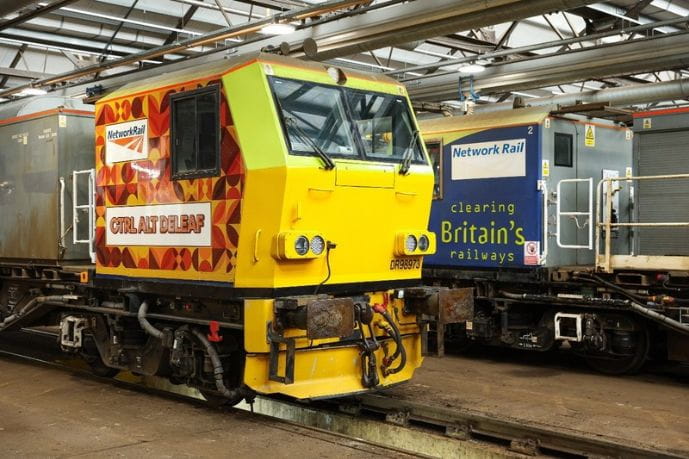
Regionally, a team of Multi-Purpose Vehicles (MPVs, pictured above) operate across our route, using high-pressure water jets to clear leaf mulch and debris from the rails.
Carrying 30,000 litres of water and delivering pressures of up to 1,500 bar, these trains run daily across most of our network, although this can vary depending on conditions.
Last Autumn they delivered treatment to almost 140,000 miles of track on our network, more than five trips around the world.
Four of the MPVs are fitted with special cameras that monitor the rails, enabling virtual inspections that would previously require teams to go out on track. improving efficiency and enhancing safety.
The MPVs are not just used in autumn. During the winter they de-ice the rails, while in summer, they also treat weeds on the track.
We work closely with our driver and fleet teams to identify and target areas of the line experiencing lower levels of adhesion, helping us concentrate on the areas which need clearing most.
These teams begin preparing for autumn as early as spring. This allows them to make the most of opportunities to treat the track outside of planned line closures and engineering works.
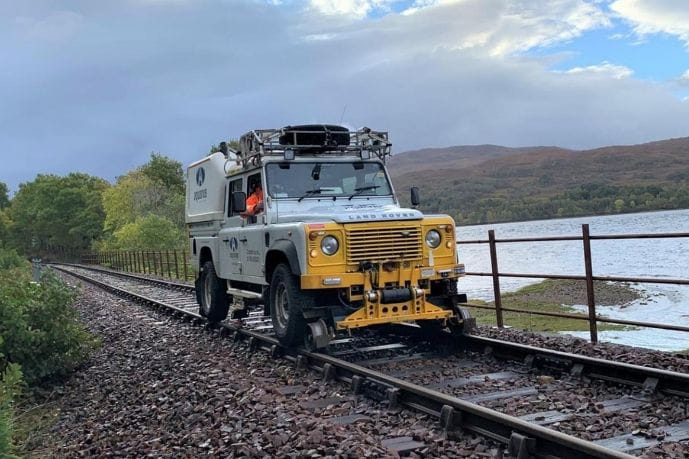
While most of the clearing is carried out by water jets, additional treatment is also carried out by a Road Rail Vehicle (RRV, pictured above), a specially designed 4x4 vehicle capable of travelling both by road and along the railway.
It sprays the rails with a treatment called Interflon, a fast-acting liquid that dissolves organic leaf matter and improves traction, which provides the additional grip needed to help trains run smoothly.
Sanding systems
Our trains are also fitted with sanding systems, which dispense sand onto the rails ahead of the trains’ wheels to provide more grip.
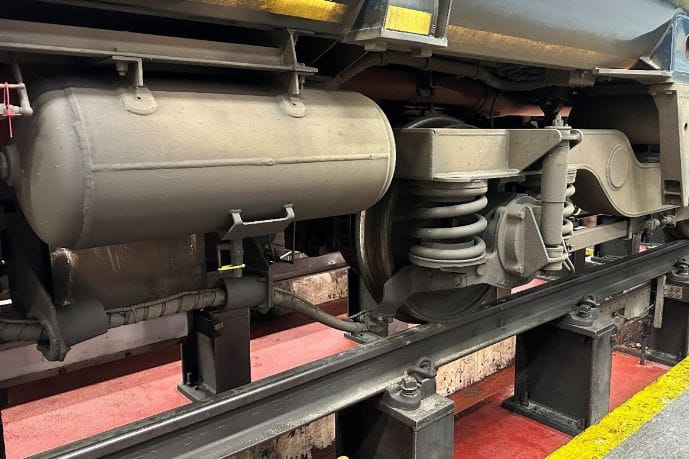
We have recently fitted an upgraded system on our Class 158 and Class 159 trains (above), the first of its kind in the country.
The specialist technology, developed by Siemens, provides a more efficient way of applying sand to the rails, adjusting the amount released depending on the trains’ speed and the track conditions.
This combined approach helps keep the rails cleaner for longer, improving adhesion while reducing the impact of leaf contamination on train performance.
Autumn timetable changes in 2026
Train services are now running to our autumn timetable, which is place until Saturday 12 December. These changes will give our drivers more time to safely brake and accelerate, which can take longer when we experience leaves on the line.
There are minor changes to train times compared to our May 2026 timetable, with services departing stations between 1 and 5 minutes earlier than usual.
For example, the 0621 service from Dorking to London Waterloo will depart at 0620, while the 0523 service from Portsmouth Harbour to London Waterloo will depart at 0518.
Journey planners are up to date and we recommend planning ahead here.
You can also download our autumn timetables here.
Additional service changes from October
Following challenging conditions last autumn, which led to poor performance across our network, we have also made changes services calling at Brookwood, Kempton Park, Longcross, Upper Halliford, West Byfleet, Winchfield and Woking.
These changes will help to keep services running reliably at key parts of our network, where even the smallest delays can quickly add up and cause longer and much more impactful delays.
Minor delays in congested areas can quickly affect the whole of our network. We need to build more time into our timetables, and our best option is to remove stops at some of our quieter stations.
We have chosen these stations due to their low customer numbers outside of peak hours, the high number of train services at these stations, and how close they are to alternative stations.
For example, Kempton Park sees up to 15 customers for each service on average outside of peak hours, and is within walking distance of Sunbury, which sees two trains an hour in each direction off-peak.
These service changes began on Sunday 4 October and will remain in place until Saturday 12 December, when our autumn timetable ends.
From now until Saturday 12 December, services at the following seven stations will no longer stop at the times below:
All other services will run as per our autumn timetable.
Does this affect the West of England timetable?
Services between London Waterloo, Yeovil Junction and Exeter St Davids will continue to run to the temporary timetable that has been in place since Monday 10 August. In addition, some services between London Waterloo and Exeter St Davids will not call at Woking, as above.
You can find out more about that timetable here.
Additional changes
When we expect challenging autumn conditions, we may make minor changes to calling patterns on off-peak services, on a small number of routes. We will communicate these changes as soon as they are confirmed on our Plan My Journey page.